Sampurna Chattarji: Neither Reckless Nor Complacent
December 14th, 20086.
Krypton is behind me.
Open the crypt if you dare.

6.
Krypton is behind me.
Open the crypt if you dare.
5.
Profundo russo.
Breathing the air is enough to ignite me, spontaneously.
I turn violent in water.
Later when the current has passed, I cool down and find
at my feet an optically pumping heart.
Gold is my ally, mercury my love.
I take pictures, I tell time.
Eyes of glass, my stomach turbine.
My safety, my health, my purity is in your hands.
Inert, you protect me.
Atomic, I move towards the next big number,
my alkaline sister, my earth metal kin.
4.
0010 0101
This binary is she.
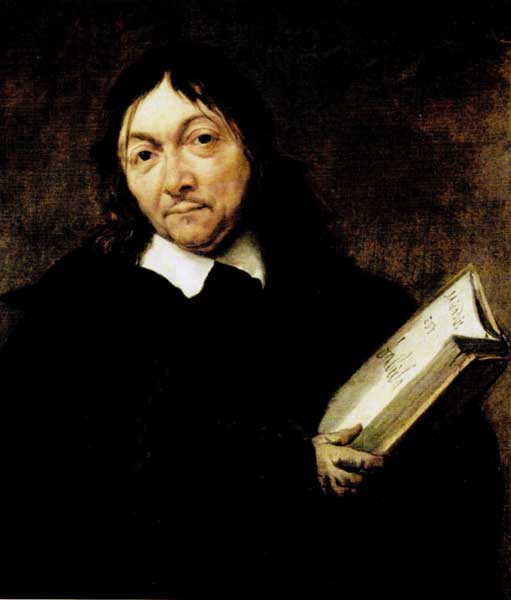
Descartes is challenged by Gaston Bachelard. And in a way the Indian painter Abir Karmakar is disciple of Gaston Bachelard. Gaston Bachelard challenges Descartes notion of clarity, distinctness and truth, notions for which Descartes became famous. Bachelard argues in his epistemologic writings, that truth is based on relations. It is dependent of the instruments which scientists have at their dispositions.
Instruments, truth and nature form a triangle, they depend reciprocally on each other. Descartes denies this when he argues that reason is equally distributed, he denies that methods are depending on language and on instruments. Descartes focusses on a universal truth, which is based on mathematics.
These mathematics have not been equally distributed in Descartes` time. Only a few scholars, seamen and traders could deal with the zero at his time.
Karmakar reminds us, that counting and therefore an important mathematical technology are based on using the body. Counting in former time was performed by touching one`s own body, fingers, feet, leg, shoulders etc. This is a documented by the observation that different cultures count on the basis of 10 fingers or 10 fingers and 10 fingers and so on.
Karmakar remembers this, when he touches different parts of his body with his tongue. This leads us to a principal epistemological question: Is counting based on using words, and therefore using the instruments of speech (mouth, teeth, tongue, etc.) or is counting a technic totally distinct from speech, a form of writing?
Nils Röller New Delhi/Sanskriti Kendra
There is a logic, or at least an analogic, an analogy between Descartes `tongue and Karmakars.
Descartes invites his reader to use reason in an unheard, untraditional and so far disturbing way. Descartes uses his reason to confirm his own existence and to deduce from this the existence of god and the world. Before Descartes the chain of reasoning was used in the opposite direction:
Out of gods existence the existence of man and reason was deduced. Descartes subverts this. He invites to try another direction, a direction disturbing and uncomfortable for believers.
This is analogic to Karmakar. He invites to use the tongue in a disturbing, uncomfortable way. A way which children like, a way which leads to selfaffection, a selfaffection which can become a stable form for regarding also the world with affection and not with disgust.
Nils Röller New Delhi/Sanskriti Kendra
3.
Irregular, unique, and sexy.
Sometimes, I feel like all three at once.
Mostly just the first.
The first irregular prime.
Symmetry, the seduction of rhyme.
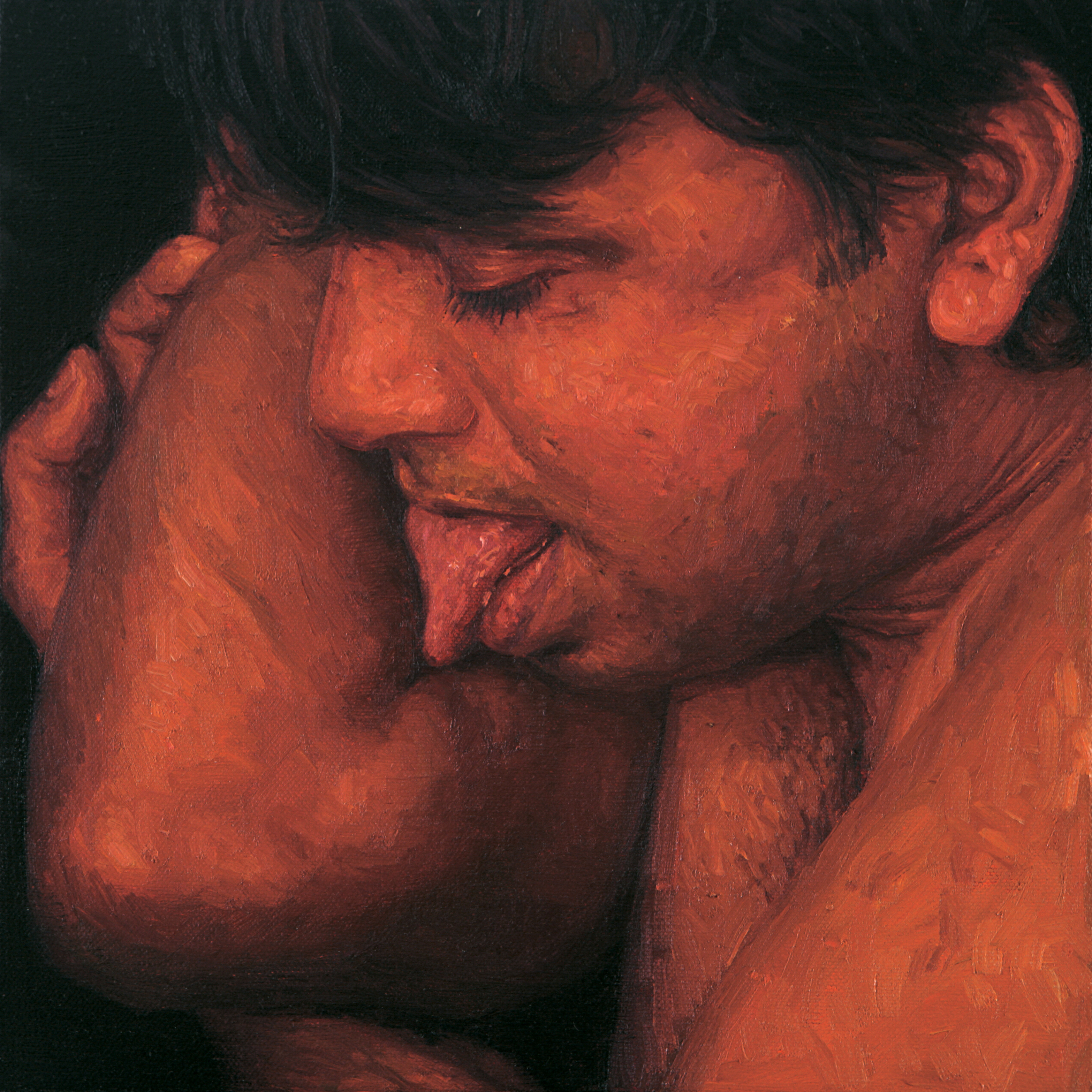
(Abir Karmakar: I Love Therefore I Am, 2006-07, oil on canvas, 30 x 30 cm ( 12 x 12 inches))
Nils Röller: On Art, Sex and Mathematics II- Interest
Tao means at first “path“.
Reading about Tao, we learn that it is all about opposites and the energy that can create a balance between two poles, for example the energy that rises up from the earth and the energy that descends from the sky. From the study of opposites it is possible to infer something about the relationship between the sexes. Tao tells us that this relationship is dynamic rather than static: a taking in and letting out of the steam that arises when water is heated, by Qi. Tao also tells of the unity and diversity that emerge from one, two and three. A linear model derives from Tao the one, then from one the two, from two the three, and from the three all things.
Another model is binary. It derives from Tao a Yin and a Yang. One Yin gives rise to connections between Yin and Yang. And one Yang gives rise to connections between Yang and Yin. Of Yin and Yang it is said that one gives off energy and the other takes it in. The intake and expenditure of energy has to do with Tao. Yin and Yang are not simply male and female, but they can indeed change the discourse about what is male and female. The Qi that flows between them is invisible; it is not restricted to organs, blood vessels or body parts, but it does change attitudes toward bodies, biological gender and gender identity. Through Qi we can conceive of male and female as poles.
Polarity is one of Oken’s central concepts. He writes:
“Polarity can be seen as a single setting of +-: and when this setting is repeated, movement results, from setting many +- +- one after the other. The main poles thus repel one another, like what happens on a iron pole when it is magnetized.” (§ 80)
Similar here does not mean the same. Oken regards nature as the realization of ideas. The sum of all ideas is zero, nothingness, which is also what constitutes God: “In the ether everything is preformed, just as everything mathematical is preformed in zero, and everything that acts is preformed in God: but this is also why nothing individual is preformed therein; instead, it comes about only when the poles are fixed in substance. This is the true meaning of the original creation of the organic.” (§ 954)
(Translation by Jennifer Taylor)
To be continued
Literature
Chen (Joseph) Cheng-Yih: “Cultural Diversities: Complementarity in Opposites”. In: Zielinski, S. und Fürlus, E. (eds.): Variantology 3. Cologne: Walther König, 2008
Butler, Judith: Das Unbehagen der Geschlechter – Gender Studies [Routledge 1990]. Frankfurt: Suhrkamp, 1991
Jullien, François: Über das Fade – eine Eloge – Zu Denken und Ästhetik in China [Arles 1991]. Berlin: Merve, 1999
Needham, Joseph: Science and Civilisation in China Vol. IV (Physics and Physical Technology), Part 1 (Cambridge, 1962)
Oken, Lorenz: Lehrbuch der Naturphilosophie. Zürich: Schulthess, 1843
Röller, Nils: “Thinking with Instruments: The Example of Kant`s Compass”. In: Zielinski, S. und Fürlus, E. (eds.): Variantology 3. Cologne: Walther König, 2008